We as regular sewist often come across with the problems like breaking the needle in middle of the sewing, fabric got stuck below the throat plate or fabric got bunched up behind the presser foot, skipped stitches. One of the most common reason of all the above problems is using wrong needle.
The most common sewing problem the sewists face is using wrong sewing machine needle. The novice sewers are actually not aware of the perfect sewing machine needle and fabric combination. Many intermediate sewers sometimes just ignore the importance of correct needle for sewing machine.
In this article I am going to discuss about sewing machine needle in a brief. You will definitely get some help from this. Lets get ahead…
What Is a Sewing Machine Needle
A sewing machine needle is a type of needle specially designed to be used in sewing machines.
Mostly sewing machine needles are made of steel coated with either nickel or chromium. Some needles have coatings of titanium nitride on coatings of chroimium. Titanium nitride reduces abrasion and allows the needle to stay shrper for longer and lasts longer than other varieties.
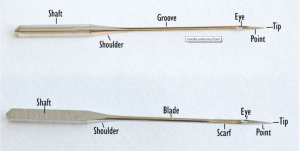
A sewing machine needle consists of
- shank – The top part or the part that is inserted into the sewing machine’s needle bar.
- shoulder – where the thick shank tapers down to the shaft. It is the slope between the shank and shaft
- shaft – This is the body of the needle below shank.
- groove -This is the narrow cut above the eye. It allows the thread to lie more closely to the needle as it passes through the fabric.
- scarf -It is the area above eye. It provides extra room for the hook or shuttle to pass close by
- eye – It is the hole at the end of the needle. It carries the thread.
- point and Tip – It is the last part of the needle. It penetrates into the fabric in sewing.
Sewing Machine Needle Sizes
The sewing machine needles with different sizes. The size is always mentioned on the packet. The size is in numeric form. Most sewing machine needles have printed their needle size both in American and European sizing form. European needle are measured 60-110 and American 8 to 18. So you will find sizes are mentioned in both the form on the packet like (70/14, 80/12). It is the same size but just in two different form. In general, bigger the size number bigger the needle.
Types Of Sewing Machine Needles
The sewing machine needles are standardized, so you dont have to look for specific brand for needles. They have made it easier for the sewers. You have to choose the needle according to the type and weight of the fabric. For that you should have a knowledge of types of sewing machine needles.
Universal Needles
These are also called all purpose needle which work with almost all types of fabrics and and also with all domestic sewing machines. These universal needle have a flat face on the needle shank. With this feature, you can ensure if the needle is inserted correctly or not. It can be used in any domestic sewing machine. These needles will not fit in industrial or commercial sewing machines.
Ball Point Needles
Ball point needle is similar universal needle but it has a slightly more rounded tip. This rounded tip helps the ball point needle to push the the fabric fibres apart without damaging it. It is best for closely knitted fabrics, interlock, cotton knits, fleece.
Stretch Needles
Stretch needles have a ball point tip like ball point needles. This type of needle has a scarf, that allows the hook to pass close by preventing skipped stitches. The ball point tips help to slip between the fabric easily without tearing and snagging them. This type of needle is good for fabrics like Lycra, spandex, power net, silk jersey and highly elastic fabrics.
Sharp/Microtex Needles
These are thinner and sharper than universal needles. The sharps needles have a short and round eye which provides extra strength while sewing. They have stronger and narrow shaft, that prevents from bent while working with several layers of fabrics. The sharp points easily pierce into the fabric. The microtex needles are good for densely woven fabrics such as silk and micro fibers. These are also suitable for quilting and applique.
Embroidery Needles
Embroidery needles have extra large eyes to allow every types of thread to pass easily. These needles have a specially shaped scarf which prevents the thread from shredding by reducing the movement of fabric.
Quilting Needles
Quilting needles are designed with an extra strong shaft and narrower and thinner point. So that it can easily penetrate into the multi layered woven fabric without breaking and tearing either the fabric or the needle.
Leather Needles
The leather needles have a special knife like triangular shaped point. So that the needle can make a large, clean hole in non woven materials like vinyl and leather.
Denim Needles
As the name suggests these needles are intended for jeans ans denims. They have very slender eye and a very sharp point. They also possess strong shank to prevent them from bending while sewing heavy fabrics.
Top Stitch Needles
These are used in top stitching. These types needles have very sharp points and also possess large eye so that thick decorative threads will easily pass through. Top stitch needles are similar to leather needles.
Twin Needles
Twin needles are also called double needles. These are the types of needles where two parallel points are attached to a single shank. basically, a single shank having two parallel needle points attached to it. These are good for sewing stretch fabrics and woven fabrics.
Wing Needles
The wing needles have flared wings on either side of the eye, that holds the fabric open. This is also called hemstitch or sword needle. They create larger holes on the fabric. These types of needles are used in creative decorative stitches, hems and borders.
Metallic Needles
Metallic needles are specially designed to use with metallic threads. They have little rounded point, extra long scarf, long eye and large groove. The eye of the needle is coated with teflon to prevent shredding of the thread while sewing.
Serger Needles
These are the needles specifically designed and can only be used in serger over Overlockers.
How To Choose The Best Sewing Machine Needle
Now the main point is how would you choose the best sewing machine needle for your fabric. It depends on
- Type of the fabric
- Size of the needle and its eye
- Type of thread
Type Of The Fabric
After selecting the fabric, now you should ask yourself, ” Which type of needle will be best for this fabric”? You cannot simply sew cotton, silk and other thin fabrics and thick fabrics with a same needle. Thickness wise these are different. You should follow the needle size chart for the guidance. Thicker fabrics needle bigger size needle and thinner fabrics need smaller size needle.
Size Of The Needle and its Eye
Needles with different sizes are available. We have discussed it earlier in this post. So always check the which needle size will perfect for your project.
Eye of the sewing machine needle also play an important role in this. If eye hole of the needle is small then thicker threads can not be inserted in the needle. So check with if the sewing needle and the thread do fit with together or not. It is better to choose a needle with larger eye.
Type Of Thread
Thicker the thread larger the needle. If you are using thicker thread then larger size needle will be suitable for them.
Conclusion
Needle selection is an important part in sewing. A wrong needle can destroy your project. So dont take it lightly. Always do a proper research before buying the needle. You must have gotten little idea about this now. So always keep a needle chart with you and follow that while selecting the best sewing machine needle.